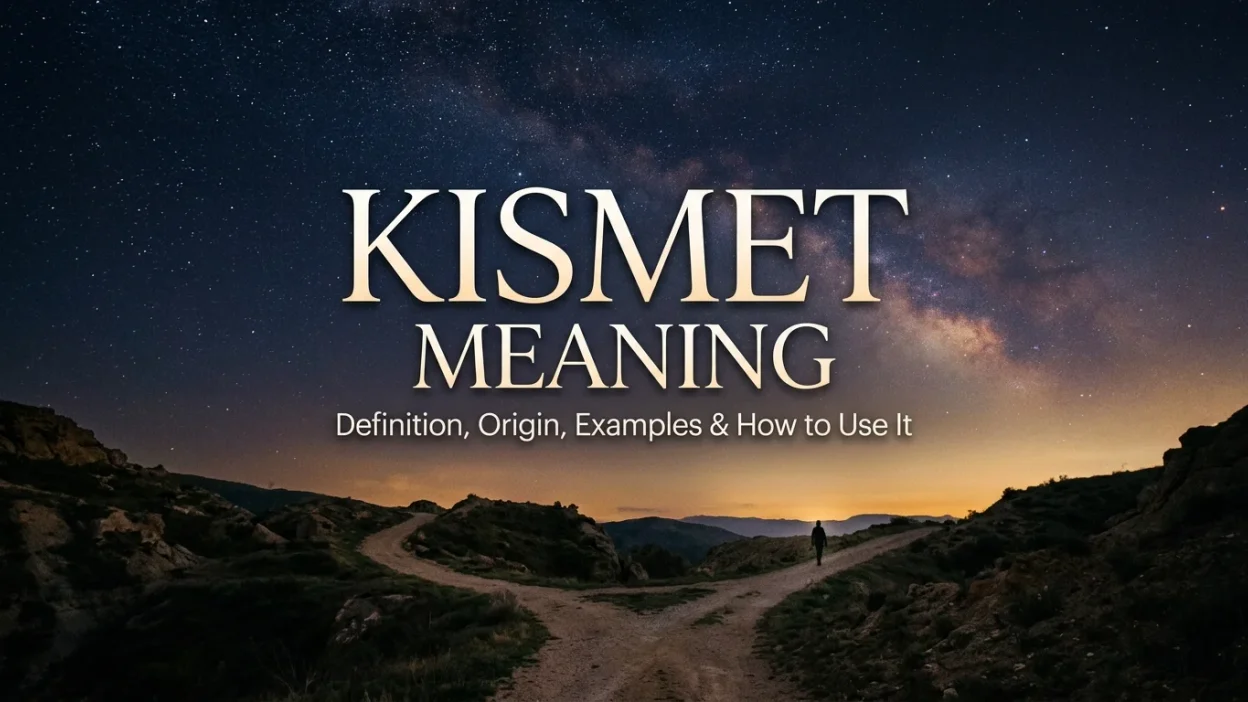
Kismet means fate or destiny—the idea that certain events in life are meant to happen. People often use the word when talking about love, relationships, unexpected meetings, and important life events that seem destined to occur. For example, if two people meet by chance and fall in love, someone might say, “It was kismet.” In simple terms, kismet describes the feeling that something was meant to be.
The word can express romance, hope, acceptance, or the belief that life follows a path beyond our control. It can also describe an unexpected opportunity, a fortunate coincidence, or an event that changes someone’s future. Although kismet is often associated with love, its meaning extends to many areas of everyday life.
Kismet Meaning and Definition
Kismet is a noun that means fate or destiny. It refers to the idea that events, experiences, or encounters may be determined by a greater force rather than by personal decisions alone.
People use the word when something happens unexpectedly and feels as though it was supposed to happen. It can describe a positive experience, a difficult situation, or an event whose outcome seems unavoidable.
For example:
- “Meeting my best friend at the airport was kismet.”
- “She believes it was kismet that brought them together.”
- “Getting that job felt like kismet.”
What Does Kismet Mean in Simple Words?
In simple English, kismet means something that was meant to happen.
Imagine missing a bus and meeting someone who later becomes your closest friend. You might look back at the experience and call it kismet because an ordinary delay led to an important relationship.
However, the word does not prove that an event was predetermined. It describes how someone interprets an experience or believes it fits into their destiny.
Is Kismet a Positive or Negative Word?
Kismet can be positive, negative, or neutral depending on the situation.
A person might use it positively when meeting a romantic partner, discovering a dream job, or finding an unexpected opportunity. On the other hand, someone might use it to describe an unavoidable disappointment or a difficult turning point in life.
For example:
- Positive: “Finding my dream home felt like kismet.”
- Negative: “He accepted the loss as kismet.”
- Neutral: “Perhaps it was kismet that we arrived at the same time.”
The word itself does not determine whether an event is good or bad. The surrounding situation gives it meaning.
Kismet Meaning in Love and Relationships
In romantic conversations, kismet often describes the feeling that two people were destined to meet. It suggests that their relationship may be more than an ordinary coincidence.
People commonly use the word when discussing unexpected meetings, strong emotional connections, and relationships that develop despite unusual circumstances.
Kismet Meaning in Love
When someone says, “Our love was kismet,” they mean that their relationship feels destined or meant to be.
For example, two people might meet while traveling, discover that they share similar interests, and eventually build a lasting relationship. They may describe their meeting as kismet because the circumstances feel remarkably meaningful.
The expression can communicate:
- A feeling that two people were meant to meet.
- A romantic connection that seems unusually well-timed.
- A belief that certain relationships happen for a reason.
- Gratitude for an unexpected relationship.
- The idea that a chance meeting changed someone’s life.
Kismet does not necessarily mean that a relationship will last forever. Instead, it describes how someone views the circumstances that brought two people together.
What Does It Mean When Someone Calls Your Relationship Kismet?
If your partner says your relationship is kismet, they are likely expressing the belief that meeting you was meant to happen.
For example:
“I never expected to meet someone like you. Maybe it was kismet.”
This statement suggests that the speaker sees your relationship as a meaningful or fortunate part of their life.
However, context matters. Someone may use kismet romantically, jokingly, or philosophically. The word alone cannot tell you everything about their feelings.
Romantic Examples of Kismet
Here are a few examples of how kismet can appear in conversations about love.
- “We met by accident, but falling in love felt like kismet.”
- “I think it was kismet that we ended up at the same party.”
- “After everything that happened, finding each other again felt like destiny.”
- “Maybe kismet brought us together at the perfect moment.”
- “Our story sounds unbelievable, but we call it kismet.”
Each example connects an unexpected event with the feeling that it had a deeper purpose.
Origin and History of the Word Kismet
The word kismet entered English through Turkish, with its deeper linguistic roots in Arabic. It is related to the Arabic word qismah or qisma, associated with division, allotment, or one’s allotted share.
Through its historical development across languages and cultures, the word became associated with fate or destiny. In modern English, it is especially useful for describing events that seem meant to happen.
Where Does the Word Kismet Come From?
Kismet is commonly traced through Turkish kismet to Arabic qismah. The idea of an allotted share developed into a broader sense of what is destined for a person.
The word became established in English and is now used in everyday conversation, literature, films, and discussions about relationships and life experiences.
Is Kismet an Arabic Word?
The English word kismet came through Turkish, while its deeper roots are Arabic. It is connected to a word associated with an allotted portion or share.
Its modern English meaning is primarily fate or destiny. Although the word has cultural and linguistic connections to Muslim societies, English speakers use it in a broad range of contexts, including romantic and secular conversations.
How Is Kismet Used Today?
Today, kismet is often used to describe meaningful coincidences. It can appear in conversations about love, careers, friendships, travel, and personal milestones.
For example:
“After years of searching, I found the perfect opportunity in my hometown. It felt like kismet.”
The speaker uses the word to express the feeling that an unexpected opportunity arrived at the right time.
How to Use Kismet in a Sentence
Kismet is a noun, so it usually appears in sentences that describe fate, destiny, or an event that seems meant to happen.
You can use it in casual conversations, personal writing, romantic messages, and storytelling. It often sounds slightly poetic or reflective, making it useful when you want to express more than a simple coincidence.
Kismet in Everyday Conversations
Here are examples of kismet in ordinary situations.
- “Meeting you at the bookstore was kismet.”
- “It was pure kismet that we chose the same vacation destination.”
- “Maybe it was kismet that I found that job advertisement.”
- “She believes their friendship was kismet.”
- “Finding my lost notebook just before the exam felt like kismet.”
In each example, kismet suggests that an event feels meaningful or unusually well-timed.
Kismet in Romantic Sentences
The word is particularly popular in descriptions of relationships.
- “Our first meeting felt like kismet.”
- “I never believed in destiny until I met you.”
- “Perhaps kismet was responsible for bringing us together.”
- “They considered their unexpected reunion an act of kismet.”
- “Sometimes love arrives when you least expect it, and that feels like kismet.”
These sentences use the word to express a sense of romantic destiny without claiming that every relationship is predetermined.
Kismet in Professional and Personal Situations
Kismet is not limited to romance. It can describe a fortunate discovery, a career change, or a surprising opportunity.
- “Finding my dream career was kismet.”
- “It was kismet that the company contacted me just as I was considering a change.”
- “Our paths crossed again, and I wondered whether it was kismet.”
- “The unexpected invitation felt like kismet.”
- “Perhaps it was kismet that led me to discover my passion.”
These examples show how the word can make an ordinary event sound meaningful or significant.
Kismet Meaning in Texting and Social Media
In texting and on social media, kismet generally means fate or destiny. People may use it to describe a romantic connection, an unexpected reunion, or a coincidence that feels important.
Unlike abbreviations such as LOL or BRB, kismet is a complete word rather than a shortened texting expression.
Kismet in Text Messages
Someone might use kismet in a private message when talking about a meaningful encounter.
Examples:
Text: “We both showed up at the same café without planning it. Kismet? ❤️”
Meaning: The sender wonders whether the unexpected meeting was meant to happen.
Text: “I still can’t believe we met that way. It was kismet.”
Meaning: The sender believes the meeting was a special coincidence.
Text: “Maybe it’s kismet that we’re talking again.”
Meaning: The sender feels that reconnecting might have a deeper significance.
Synonyms and Related Words
Several words are related to kismet. Choosing the right one depends on whether you want to emphasize fate, purpose, chance, or a fortunate experience.
1. Fate
Meaning: Events believed to be determined or beyond a person’s control.
Example: “They believed fate had brought them together.”
Fate is one of the closest synonyms for kismet.
2. Destiny
Meaning: A future or outcome believed to be predetermined or intended.
Example: “She felt that becoming an artist was her destiny.”
Destiny often focuses on a person’s future or life path.
3. Serendipity
Meaning: The experience of finding something good or valuable by chance.
Example: “Finding that little bookstore was pure serendipity.”
Serendipity emphasizes a fortunate discovery rather than the belief that an event was predetermined.
4. Fortune
Meaning: Luck, chance, or circumstances that influence what happens.
Example: “By good fortune, we arrived just in time.”
Fortune can refer to favorable or unfavorable circumstances, depending on the context.
5. Providence
Meaning: The belief that events are guided by divine care or a higher power.
Example: “She believed providence had guided her through difficult times.”
Providence often carries a religious or spiritual meaning that kismet does not necessarily imply in everyday English.
6. Coincidence
Meaning: An unexpected occurrence of events at the same time or in a related way.
Example: “What a coincidence that we went to the same school!”
Coincidence is a useful alternative when describing an unexpected event without suggesting that it was destined to happen.
Opposite of Kismet
Kismet has no single perfect antonym, but several expressions communicate contrasting ideas.
Chance or Randomness
Chance describes events that happen without a clearly established plan or predetermined outcome.
Example: “We met by chance, and neither of us expected it.”
This differs from kismet because the speaker does not necessarily believe the meeting was meant to happen.
Free Will
Free will is the ability to make choices independently. It is often discussed in contrast with fate or determinism.
Example: “I believe our choices shape our relationships more than fate does.”
Free will is not a direct dictionary antonym of kismet, but it represents a contrasting idea in philosophical discussions.
Accident
An accident is an unplanned or unintended event. Depending on the circumstances, it may be fortunate or unfortunate.
Example: “Our meeting was an accident, but we became good friends.”
Someone might describe the same encounter as kismet if they later feel it was meaningful.
Common Misunderstandings About Kismet
Although kismet is a simple word, its connection to fate can lead to a few misunderstandings.
Kismet Always Means Romantic Love
Kismet is often used in love stories, but it does not specifically mean romantic love. It can describe friendships, job opportunities, unexpected discoveries, and other life events.
For example, finding a supportive mentor at the right time could feel like kismet even when no romantic relationship is involved.
Kismet Proves That Something Was Meant to Happen
The word expresses an interpretation or belief about an event. It does not establish that the event was objectively predetermined.
Someone may describe meeting a partner as kismet, while another person may view the same meeting as coincidence.
Kismet and Coincidence Mean Exactly the Same Thing
The words overlap, but they are not identical in tone. Coincidence describes an unexpected occurrence, while kismet often suggests that the occurrence feels destined or meaningful.
For example, meeting an old friend unexpectedly is a coincidence. Calling it kismet adds the speaker’s sense that the reunion happened for a reason.
Kismet Means You Cannot Change Your Future
Kismet is associated with fate, but people use the word in different ways. Some believe strongly in predetermined events, while others use kismet figuratively to describe meaningful experiences.
Using the word does not automatically mean that someone rejects personal choice or responsibility.
FAQs About Kismet
What does kismet mean in simple words?
Kismet means fate or destiny. In simple words, it describes something that feels as though it was meant to happen. People often use it when talking about unexpected meetings, romantic relationships, fortunate opportunities, or important events that seem meaningful.
What does kismet mean in love?
In love, kismet describes the feeling that two people were destined to meet or develop a relationship. For example, someone might say, “Meeting you was kismet,” to express that their connection feels special or meant to be.
Is kismet a positive word?
Kismet is not exclusively positive or negative. People often use it to describe fortunate encounters or romantic connections, but it can also refer to difficult events that seem unavoidable. The emotional meaning depends on the context and the speaker’s perspective.
Is kismet an Arabic word?
The English word kismet entered the language through Turkish and is ultimately related to Arabic qismah, meaning an allotted share or portion. In modern English, kismet primarily means fate or destiny.
What does kismet mean in texting?
In texting, kismet means fate or destiny. Someone might use it when an unexpected meeting or relationship feels meant to happen. It is a regular word, not a standard abbreviation, and its intended tone depends on the message.
What is the difference between kismet and destiny?
Both words refer to fate or something believed to be meant to happen. Destiny often emphasizes a future outcome or life purpose, while kismet is frequently used for meaningful encounters and unexpected events. Their meanings overlap in everyday conversation.
What is another word for kismet?
Fate and destiny are the closest synonyms for kismet. Other related words include fortune, serendipity, and providence. However, each has a slightly different emphasis, so the best alternative depends on the sentence and intended meaning.
How do you use kismet in a sentence?
You can use kismet as a noun when describing an event that feels destined. For example, “Meeting my best friend while traveling was kismet.” This sentence suggests that the unexpected meeting became an important part of the speaker’s life.
Conclusion
Kismet means fate or destiny—the feeling that certain events are meant to happen. The word is especially common in discussions about love, unexpected meetings, meaningful coincidences, and important life experiences.
Although kismet is often used romantically, it can describe many situations beyond relationships. It also differs slightly from words such as coincidence and serendipity because it often suggests a sense of destiny rather than simply an unexpected event.
Ultimately, kismet is a way to describe how people interpret meaningful moments in their lives. Whether you use it to talk about love, friendship, or an unexpected opportunity, it expresses the feeling that an experience happened for a reason.

Olivia Bennett is a content writer who specializes in word meanings, internet slang and everyday expressions. She enjoys creating clear, informative content that helps readers understand language and discover the meanings behind words.